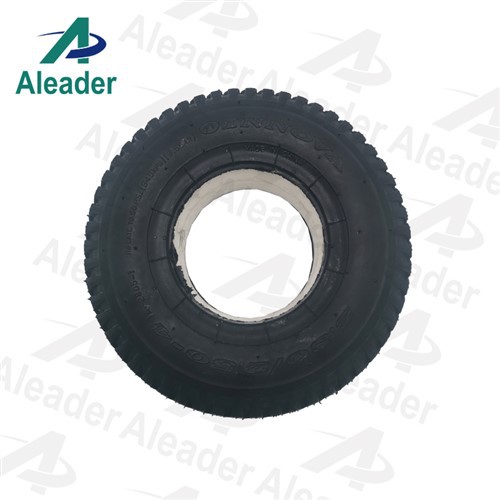
The Types of Tyres
According to the composition structure of the tyre, it can be divided into Tube tyre and Tubeless tyre.
A. Tube Tyre
This type of tire consists of a tire, an inner tube and a cushion belt.
1. Tire
The outer tube is a high-strength and elastic shell made of wear-resistant rubber, which directly contacts the ground to protect the inner tube from damage. It consists of bead, buffer layer, tread and cord layer.
①Tread: The tread is the outer surface of the tire, including the crown, shoulders and sidewalls. The crown is also called the running surface. It directly contacts the road surface, withstands impact and wear, and protects the carcass from mechanical damage. In order to increase the adhesion between the tire and the road surface and prevent vertical and horizontal slippage, various patterns are made on the crown. The shoulder is the transition between the thicker crown and the thinner sidewall, and there are also various patterns to prevent slippage and heat dissipation. The sidewall is a thin rubber layer attached to the side wall of the carcass layer. Its function is to protect the carcass layer of the sidewall from mechanical damage and water erosion. The sidewall is not in contact with the ground and generally does not wear out, but it is subject to large deflections.
②Ply layer: The ply layer is the skeleton of the outer tire, also known as the carcass. Its main function is to bear the load (car gravity, road impact and internal air pressure), and maintain the size and shape of the tire outer edge. The ply is usually composed of multiple layers of gelled cotton threads or other fiber braid, and they are arranged in a cross at a certain angle. In order to distribute the load evenly, the number of plies is more even. The number of plies should be determined according to the load, internal pressure and type and use of the tire. Generally, the number of plies is marked on the surface of the tire.
③Buffer layer: The buffer layer is located between the tread and the ply, and is soft and elastic. Its function is to strengthen the combination of the tread and the carcass, so as to alleviate the impact of the uneven road that the car is subjected to while driving, and to prevent the car from being detached from the carcass during emergency braking.
④Bead: The bead is the foundation of the ply. It is fixed on the rim by the bead. The bead is composed of a steel wire ring, a cord ply and a bead wrap.
2. Inner tube
The inner tube is a ring-shaped rubber tube with a valve on it to fill or expel air. The inner tube is filled with compressed air at a certain pressure. -Tires with a general air pressure of 0.5 to 0.7 MPa are called high-pressure tires, tires with 0.15 to 0.45 MPa are called low-pressure tires, and tires with 0.15 MPa or less are called ultra-low-pressure tires. Almost all cars and trucks use low-pressure tires. Because the low-pressure tires have good elasticity, wide cross-section, large contact surface with the road, thin walls and good heat dissipation, they improve the smoothness of driving and the stability of steering. At the same time, the life of the road and the tire itself has been extended. However, due to the improvement of rubber performance, the load capacity of the tire has been greatly improved. Although the tire pressure is already in the range of the high-pressure tire, the cushioning performance of the tire still maintains the performance of the original low-pressure tire of the same specification. This type of tire is still classified as a low-pressure tire. Column.
3. Cushion
The cushion belt is an endless rubber belt, which cushions between the inner tube and the rim, protects the inner tube from being worn by the rim and the bead, and prevents dust and moisture from immersing in the tire.
4. Radial tires
The cord of the radial tire ply is close to the radial cross section of the tire, that is, it is arranged at 90 ° or close to 90 ° with the center line of the tread, and the carcass is tightened by the belt layer. Its characteristic is that the arrangement of the cord can make its strength fully utilized, so its number of cord layers can be reduced by nearly half compared with ordinary tires, and there is no even number limit, so the carcass is soft; the cord only depends on rubber in the circumferential direction To contact. In order to withstand the greater tangential forces generated when the car is running, the radial tire has several layers of cords with a large angle (intersection angle 70 ° ~ 75 °) to the meridian cross section, a high-strength, hard-to-stretch circumferential ring-like buffer layer belt Bundle. At the same time, the belt layer is made of cord material with high strength and small expansion rate, so the belt layer is hooped like a rigid hoop on the carcass, which greatly improves the rigidity and strength of the tread.
Compared with ordinary bias tires, radial tires have better wear resistance, greater elasticity, and longer mileage (more than 50% longer than ordinary tires); low rolling resistance and fuel saving (rolling resistance can be reduced by 25% ~ 30%, Fuel consumption is reduced by about 8%); large load capacity, good damping performance and adhesion performance, tread puncture resistance and light weight. However, the sidewall is easily cracked, the bead is easily damaged, and the lateral stability is poor, and the cost is high.
Radial tires use the same rims as ordinary tires. In use, radial tires and ordinary tires cannot be installed side by side, nor can they be coaxially mixed. When inflated, the internal pressure of general truck radial tires should be about 0.2 MPa higher than the corresponding ordinary tires. Radial tires are widely used in cars and some medium-sized trucks.
5. Diagonal tires
Diagonal ply tires are referred to as bias tires, whose name is derived from the carcass structure as the most important part of the tire. Weave a thin horizontal line and a thick vertical tire cord into a cloth, and thinly apply raw rubber on both sides of the cloth, which is called a cord. Then cut the diagonal of the cord (oblique cut), the cut fabric is called the ply, and the latter is attached to the forming cylinder, so that the tire carcass is formed, the name of the diagonal ply tire is from here Here.
The tire forming process and structure of the bias tire are shown in Fig. 5, and the obliquely cut cord is layered on the circular ring-shaped forming tube layer by layer. The cord direction of the first layer of cord, that is, the angle formed with respect to the circumferential direction, is called the cord angle. If the cord angle is set to a 0010010 #39;, the second layer of the fabric that crosses the cord direction and the first layer is also attached to the forming cylinder at the cord angle a 0010010 #39;. Because the cords cross, this type of tire is also called a cross-ply tire. Wrap the ends of both sides of the ply thus bonded onto the bead traveler and fix it. Afterwards, tread rubber, sidewall rubber, etc. are pasted on the outer periphery of the carcass to form a green tire.
A buffer layer can also be attached near the carcass as needed. After the green tire that has been formed is removed from the forming tube, the interval between the bead portions is immediately reduced from A → B, C → D. At the same time, a cylindrical capsule (called a water tire) is installed inside and filled with a high-pressure medium to expand the water tire, shape the green tire, and then scrape the carcass part into a ring shape.
B. Tubeless Tyres
The tubeless tire is similar in appearance and structure to the tubeless tire, except that it has no inner tube and pads, and the air is directly pressed into the outer tube. The sealing performance is guaranteed by the outer tube and the rim. The inner wall of the tubeless tire is attached with a rubber sealing layer with a thickness of about 2 to 3 mm, which is specially used for air sealing, and some are also attached with a self-adhesive layer made of a special mixture under the layer. When the tire is perforated, the self-adhesive layer can bond the punctured holes by itself, so this tire is also called a tubeless tire with a self-adhesive layer. There is also a bead rubber seal layer on the outside of the bead to increase the air tightness of the bead and rim. The bottom of the rim is inclined and coated with a uniform layer of paint. The valve is directly fixed on one side of the rim, the rubber seal between the gasket is used, and the nut is screwed tightly. The rivets riveting the rim and spokes are inserted from the inside and coated with a layer of rubber.
The advantages of tubeless tires are that they only fail when they are blasted, and the air leakage during perforation is slow, and the tire pressure does not drop sharply and can continue to travel; at the same time, because there is no tube, the friction generates less heat, the heat dissipation is fast, suitable for high speed Driving; in addition, it has a simple structure and low mass.
The disadvantage of tubeless tires is that the sealing layer and the self-adhesive layer are easy to leak air, and it is difficult to repair on the way. In addition, the self-adhesive layer can only be bonded when the perforation size is not large. When the weather is hot, the self-adhesive layer may soften and flow down to disrupt the wheel balance. Therefore, tubeless tires without a self-adhesive layer are generally used. Its inner wall of the tire has only one sealing layer. After the tire is perforated, it is tightly wrapped with punctures because of its compression state, so it can not leak air for a long time. Even if the puncture is pulled out, it can temporarily maintain the air pressure in the tire. Tubeless tires are generally used with deep rims in cars.